
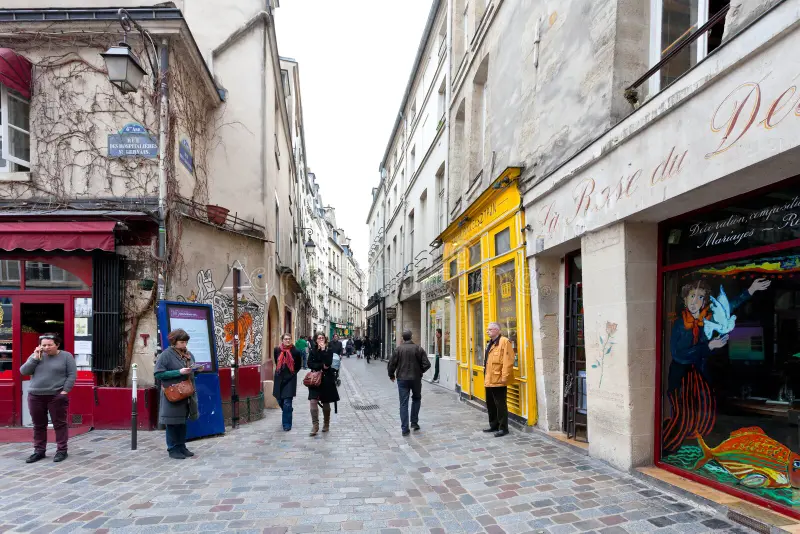
Le Marais is one of those neighborhoods you don’t just visit; you live in it for a day. With its 17th-century private mansions, contemporary and modern art galleries tucked between two bakeries, and the Place des Vosges where time seems to stand still… The Le Marais district is one of the most highly sought-after in Paris, and one of the easiest to reach from the Left Bank.
From the Hôtel Saint-Christophe, our charming boutique hotel nestled on Rue Lacépède in the 5th arrondissement of Paris, the heart of Le Marais is just 22 minutes away—a single bus ride with the window open to the banks of the Seine. There is no need to book overpriced accommodation in the 4th arrondissement to fully enjoy it: the ideal base for your stay is right here. Quiet, centrally located, and much more affordable, our room selection adapts to all your travel desires.
Le Marais in Paris: One Neighborhood, a Thousand Lives
A Walk Through the Centuries: The History of Le Marais
Its name gives it away: before becoming one of the trendiest hubs in the city and in France, Le Marais was literally a marsh (marais). In the 13th century, monks began draining these wetlands along the Seine, laying the foundation for a historic district that would become the beating heart of Paris.
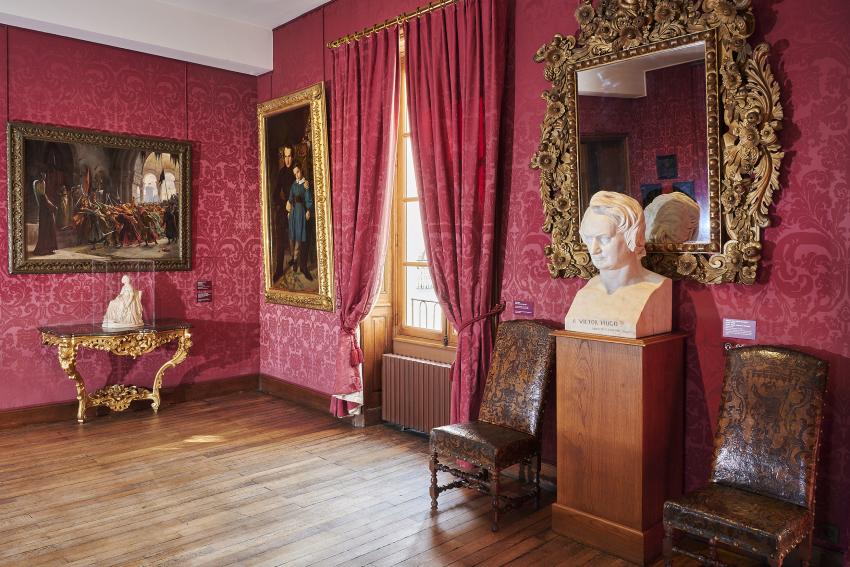
History took a turn in the 16th century when King Henry IV decided to build the Place des Vosges. Inaugurated in 1612 as the Place Royale, it immediately became the gathering place for French nobility. The most beautiful hôtels particuliers (private mansions) blossomed around it, these lavish stone residences where the old Parisian aristocracy held their literary salons. Madame de Sévigné wrote her famous letters here. Molière performed his first plays here. Meanwhile, the Maison de Victor Hugo houses the memories of the writer who spent twenty years of his life there.
Then came the Revolution. The nobility fled, and each grand private mansion fell into obscurity, taken over by artisans, tanners, and small shopkeepers. It was precisely this relative abandonment that saved Le Marais: when Baron Haussmann redesigned Paris in the 19th century, he bypassed this area. The medieval alleyways, cobbled courtyards, and Renaissance facades survived intact.
Its rebirth arrived in the 1960s, driven by André Malraux and his heritage protection laws. Le Marais was classified, renovated, and rediscovered. Today, it is home to the Picasso Museum, the Centre Pompidou, the Carnavalet Museum, and one of Europe’s most vibrant LGBTQ+ communities—a unique, modern, and magnificent blend.
What to Do in Le Marais
1. Place des Vosges and the Maison de Victor Hugo
Resist the temptation to just pass through. The Place des Vosges deserves to be properly enjoyed at least once. Pick a bench under the brick and stone arcades on the north side (shaded in summer), watch children playing near the fountains, students reading on the large lawns, and café patrons looking for the perfect photo angle. This is where Paris is most truly itself: lively, diverse, and effortlessly elegant.
Do not miss visiting the Maison de Victor Hugo, located at number 6 on the square. This apartment-museum, where the author wrote many of his masterpieces, intimately immerses you in his creative and political world.
A Parisian’s inside tip: Enter the square through the discreet passageway at 9 Rue de Birague rather than the main entrances. You will avoid the tour groups and discover the square the way Parisians do—gradually, like a well-kept neighborhood secret.
2. The Carnavalet Museum: Paris Told to Paris
This is the museum of the city’s history, housed in two connecting Renaissance mansions. Good news for your travel budget: access to the permanent collection is completely free. The galleries cover 2,000 years of Parisian history, from Gallo-Roman ruins to May ’68 posters. The reconstruction of Marcel Proust’s bedroom, transported here piece by piece, is reason enough alone to visit.
3. Rue des Rosiers: L’As du Fallafel and the Little Yellow Bakery
Rue des Rosiers is the historic heart of Paris’s Ashkenazi Jewish quarter. Its delis, Hebrew signs, and legendary falafels (at L’As du Fallafel—yes, the line is worth the wait) create an unparalleled atmosphere. This is the Paris of yesteryear, resisting gentrification and preserving its traditions in a city center that is changing all around it.
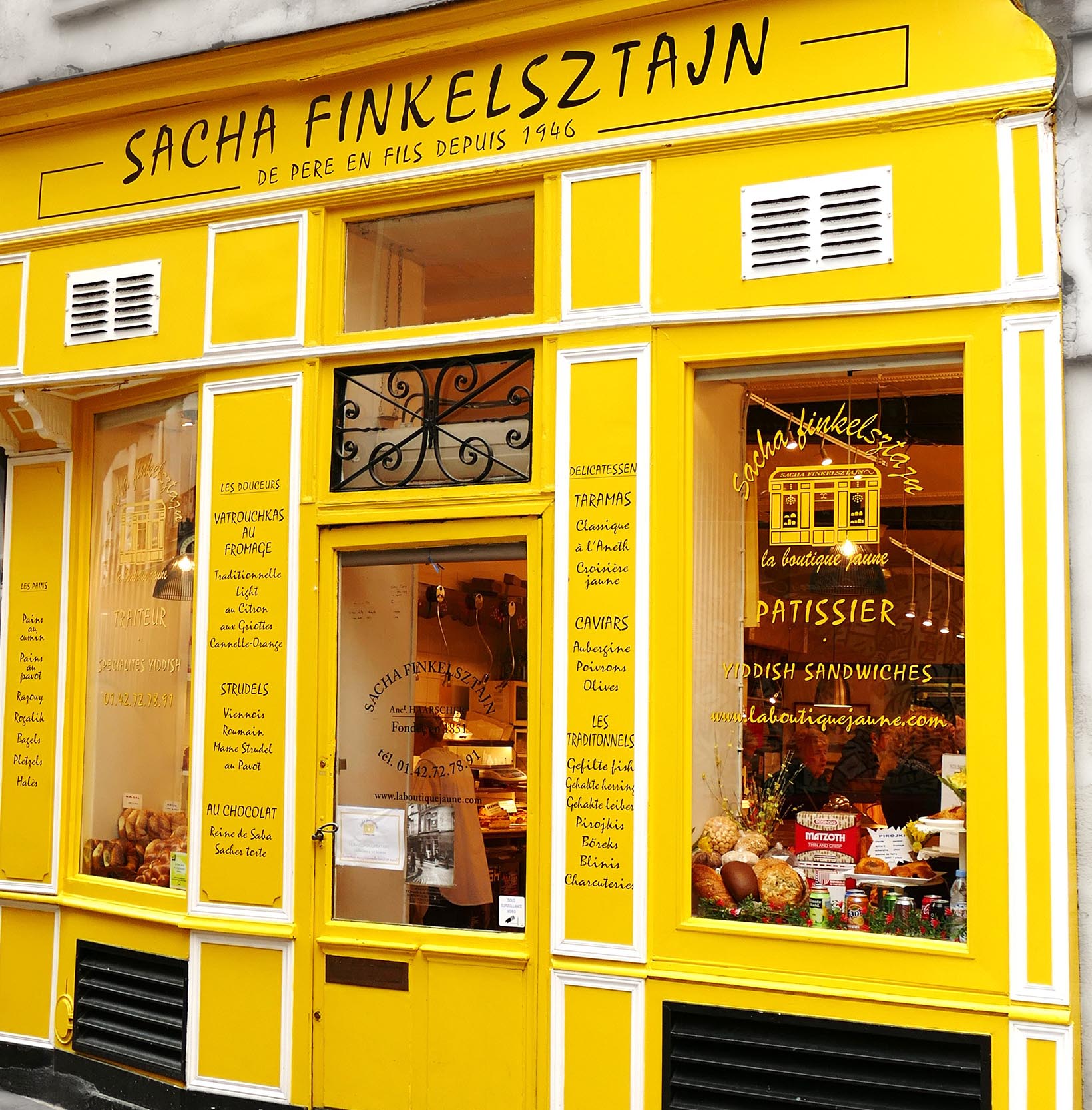
Facing the parade of tourists stands another true neighborhood institution: Sacha Finkelsztajn. Nicknamed “the little yellow bakery” by regulars, this iconic deli is a Yiddish gastronomy paradise. People come from all over Paris to buy the traditional Shabbat challah (delicious in its mini “rhale” version), cumin bread, onion Rogalik, or the famous Reine de Saba cake. Do not leave without trying their must-have Bulgarian sheep’s cheese Boreks or their famous Vatroushka.
4. The Picasso Museum: A Masterpiece in a Jewel Box
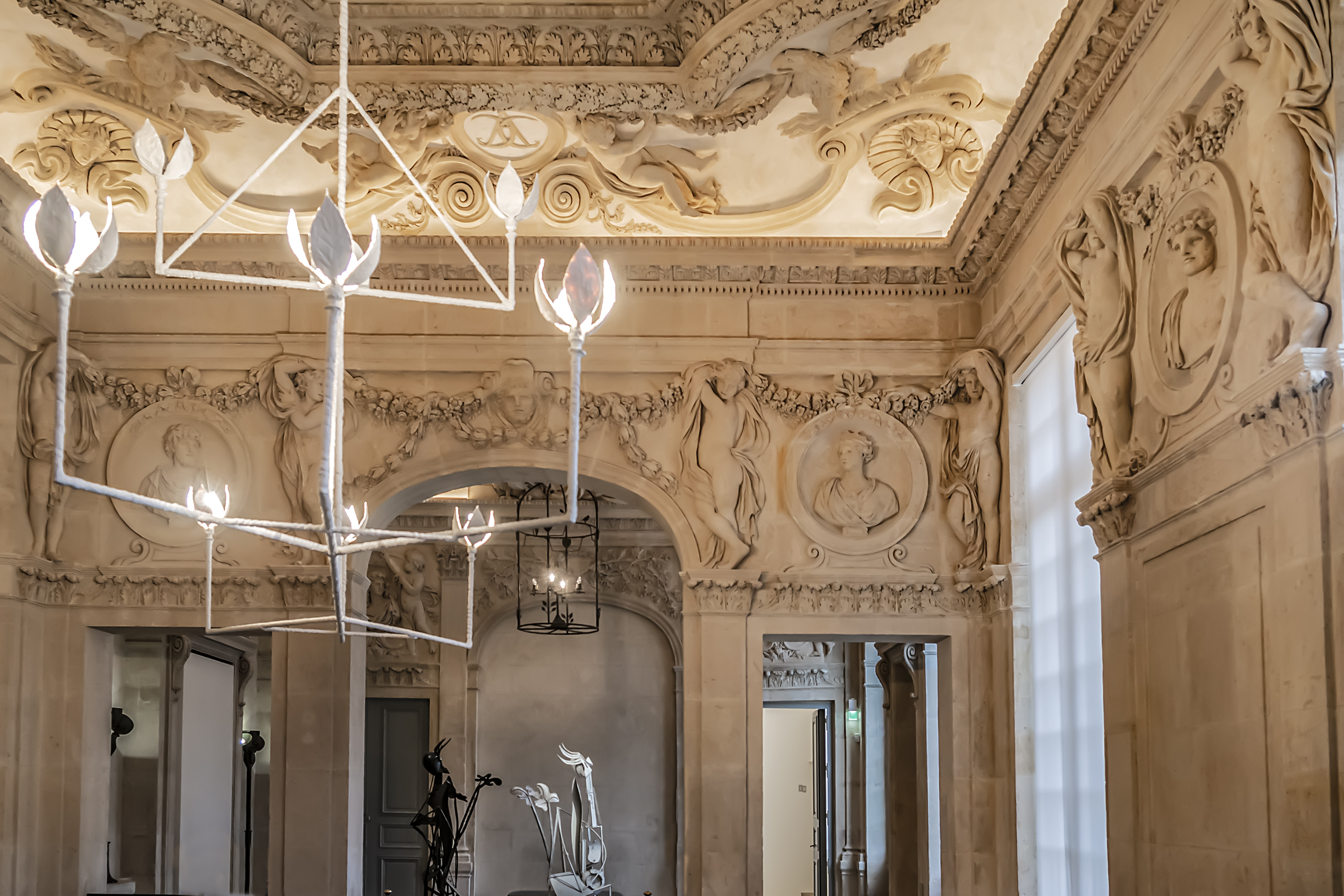
The Hôtel Salé, built in 1659 by a tax farmer in charge of the salt tax (hence its name “salé” or salty), now houses the largest collection of Picasso’s works in the world. Over 5,000 creations span the painter’s entire career. The visit is made even more beautiful by the classic architecture of the rooms and the mansion constantly engaging in a dialogue with the modern art on display.
Hidden Treasures of Le Marais
Village Saint-Paul: A Secret Between the Walls
Slip under the porch at 23 Rue Saint-Paul, just a stone’s throw from the Place de la Bastille. You will emerge into a series of interconnected medieval courtyards housing antique dealers, galleries, and flea markets. It is one of the least frequented spots in the touristy Marais, yet one of the most authentic. On a Sunday afternoon, it takes on a provincial village atmosphere—just a ten-minute walk from Notre-Dame and the Île Saint-Louis.
Hôtel de Sens: A Forgotten Fortress
At 1 Rue du Figuier stands an incredibly rare historic relic: one of the only medieval civil buildings still standing in Paris. The Hôtel de Sens, built between 1475 and 1519 for the Archbishops of Sens, looks like a fortified castle straight out of the Middle Ages. Today, it houses the Forney Library, specializing in decorative arts. The inner courtyard, freely accessible, is one of the best-kept secrets of old Paris.
The Secret Courtyards of Rue du Bourg-Tibourg
Few visitors know this: several buildings on Rue du Bourg-Tibourg and Rue Sainte-Croix-de-la-Bretonnerie hide interior courtyards accessible through slightly ajar doors. Push open the carriage doors (the ones left unlocked)—you will discover hanging gardens, artists’ studios, and spiral staircases leading up to unlikely apartments.
From Hôtel Saint-Christophe to Le Marais: How to Get There
Walking Option — Crossing from the Left Bank (35-40 min)
This is how Parisians make the journey on a Sunday morning, coffee in hand, to savor the day.
Leave from Rue Lacépède, head down towards the Seine via Rue Monge or Rue du Cardinal Lemoine. Walk along the quays of the Île Saint-Louis—take the time to stop at the Pont de la Tournelle for a unique view of the Notre-Dame Cathedral. Cross the Île Saint-Louis via Rue Saint-Louis-en-l’Île (grab a Berthillon ice cream if the timing is right), then the Pont Marie will drop you off directly in the heart of Le Marais, right in front of the Hôtel de Ville (City Hall).
- Distance: 2.8 km
- Duration: 35 to 40 minutes walking
- Elevation: Almost flat
Public Transport Option — Fast and Effortless (22 min)
From the Cardinal Lemoine – Monge stop, take Bus 75. Get off at the Saint-Paul stop (6 stops). You are dropped right into the heart of the historic Marais, just 50 meters from Rue des Rosiers.
- Line: Bus 75
- Departure: Cardinal Lemoine – Monge
- Arrival: Saint-Paul
- Frequency: Every 10 minutes
- Fare: €2.15 (t+ ticket)
- Metro alternative: Line 7 from the Place Monge station → Opéra, then transfer to Line 1 → Saint-Paul (25 min, 1 change).
The Latin Quarter and Surroundings: Other Major Sites Accessible on Foot
The central location of Hôtel Saint-Christophe allows you not only to easily reach the Right Bank, but also to branch out to all the heritage treasures of the 5th arrondissement and its surroundings:
- The heart of history and science: Our location puts you just steps away from a lush escape at the Jardin des Plantes and its galleries like the National Museum of Natural History. Antiquity enthusiasts will also enjoy exploring the Arènes de Lutèce, a spectacular Gallo-Roman ruin from the 1st century nestled just a 5-minute walk from our establishment.
- The great landmarks of the Left Bank: Heading up towards the Sainte-Geneviève hill, your path leads straight to the imposing silhouette of the Panthéon, before crossing the historic facades of the Sorbonne, the beating heart of intellectual excellence since the Middle Ages. For a more confidential cultural stop, plan a visit to the Pierre and Marie Curie Museum, located less than 10 minutes from our doors.
- Parisian art de vivre and strolling: If you love the atmosphere of traditional markets and local food shops, our address is ideal for strolling down the legendary Rue Mouffetard. This street leads to the lively terraces of the Place de la Contrescarpe, perfect for grabbing a coffee. A little further west, let yourself be tempted by a reading break on the iconic green chairs of the Luxembourg Gardens.
- A perfect connection to the whole city: Business travelers or academics will appreciate our immediate proximity to the Jussieu campus and healthcare facilities like the CMCO in Paris. Heading down to the quays, it takes just a 15-minute walk along the Seine to admire the forecourt of Notre-Dame de Paris. Finally, to facilitate your arrivals and departures from the capital, the hotel provides quick access to the Gare de Lyon as well as the Gare d’Austerlitz.
Why Choose Hôtel Saint-Christophe to Explore Le Marais?
Many travelers search on Booking.com or other sites to find a hotel near Le Marais and end up paying a premium for a room in the 4th arrondissement—often noisy, often tiny, and always drowning in crowds.
Hôtel Saint-Christophe offers a different booking logic: that of the smart traveler.
From Rue Lacépède, you are not in the middle of Le Marais’s hustle and bustle—you are in a better spot. The Le Marais neighborhood is 22 minutes away. But you are also at the ideal starting point for a visit to the Latin Quarter. In a single day from your room, you can walk through four centuries of Paris on foot.
What our guests tangibly gain by choosing our establishment:
- Peace and quiet: Rue Lacépède is a preserved residential street. You will actually sleep, far from the noise of the bars in Bastille or Central Paris.
- Space: Our 31 high-quality, air-conditioned rooms are designed for rest and comfort, not for optimizing every square meter.
- Hospitality and service: Our team is available 24/7 to manage your reservation, assist you, and recommend the best restaurant addresses or tours.
- Rates: For an equivalent category, the 5th arrondissement is consistently more competitive in price than the 4th or 6th arrondissements.
Le Marais is a flagship destination in your Paris itinerary. Hôtel Saint-Christophe is your home.
Discover Our Rooms & Suites
Whether you are traveling solo, as a couple, or on business, find the ideal cocoon for your Parisian stay:
Single Room
1 person . 1 bed
À partir de 105€
Double Room
2 people . 1 double bed
À partir de 115€
Twin Room
2 people . 2 x 1 single bed
À partir de 115€
Single room
1 person . 1 bed
À partir de 105€
Double Room
2 people . 1 double bed
À partir de 115€
Twin Room
2 people . 2 single bed
À partir de 115€
FAQ — Visiting Le Marais from the Latin Quarter
Looking for a hotel near Le Marais to fully enjoy Paris? Discover how the Latin Quarter stands out as the perfect starting point to easily explore the heart of the capital.
Can you walk to Le Marais from the Latin Quarter?
Yes, and it is one of the most beautiful walks in the city. Starting from our hotel located on Rue Lacépède, you can reach the Le Marais district in Paris in a 35 to 40-minute walk via the quays of the Île Saint-Louis. This stunning route runs along the Seine and passes right by Notre-Dame. If you prefer public transport, Bus 75 from the Cardinal Lemoine stop will drop you off at Saint-Paul in just 22 minutes.
What is the ideal alternative for staying near Le Marais in a quiet area ?
Rather than looking exclusively for a hotel in Le Marais, where overcrowding can sometimes disrupt a peaceful night’s sleep, staying in a charming establishment ideally located in the 5th arrondissement like Hôtel Saint-Christophe offers an excellent compromise. You get to enjoy a much more peaceful and authentic neighborhood for your stay, fairer rates for equivalent services, while keeping the heart of Le Marais just 20 minutes away.
When is the best time to visit the Le Marais district ?
Sunday is traditionally the liveliest day in Le Marais, as the vast majority of boutiques, art galleries, and restaurants remain open (unlike the rest of Paris). If you are looking for a more intimate experience and want to enjoy the Place des Vosges or the hidden courtyards without the crowds, opt for weekday mornings instead.
How much time do you need to visit Le Marais ?
Plan for a full day to enjoy a visit that is both cultural and relaxing: a morning at the Carnavalet Museum or the Picasso Museum, lunch with local specialties on Rue des Rosiers, and an afternoon relaxing at the Place des Vosges to discover the private mansions. If you wish to include a comprehensive visit to the modern art galleries of the Centre Pompidou, add an extra half-day to your travel itinerary.
What are the must-see museums in Le Marais ?
The three museums not to be missed during your stay are the Carnavalet Museum (free access to the permanent collections dedicated to the history of Paris), the Picasso Museum (which houses a unique collection in the Hôtel Salé), and the Maison de Victor Hugo (located directly under the arcades of the Place des Vosges).
For contemporary art lovers, the Centre Pompidou marks the western border of the district. Our reception team is entirely at your disposal to help you plan your customized itinerary.